


Skills-based hiring is on the rise, with an 11% increase in adoption over the past couple of years. As organisationsorganizations face persistent skills shortages, the need to build diverse and agile workforces is on the rise. Hiring teams are increasingly exploring non-traditional recruitment methods in their quest for talent, and in 2026, AI has become a genuine enabler of doing this well.
As the skills-based hiring approach remains uncharted territory for many organisationsorganizations, let’s break down what skills-based hiring is, its benefits, and how you can get started.
What is skills-based hiring?
Skills-based hiring focuses on evaluating candidates based on their skills, capabilities, and potential rather than traditional criteria like education, qualifications, or work experience. This approach uses a skills ontology, a method for defining and measuring relationships between skills, jobs, and people. It creates a dynamic language that connects skills across various roles, industries, and subject areas.
The benefits of skills-based hiring
Increase talent pools
By looking beyond formal qualifications and job history, skills-based hiring uncovers a broader range of skilled professionals who might otherwise be overlooked. This method can expand your talent pipeline by more than nine times, increasing your chances of finding the perfect fit for your team.
Improve DEI
Focusing on skills rather than traditional qualifications levels the playing field for underrepresented groups who have followed alternative educational or career paths. An astounding 90% of employers using skills-based hiring have observed an increase in workplace diversity.
Create organisationalorganizational agility
Shifting from rigid job requirements to a skills-based framework allows for greater flexibility. Companies can quickly adapt to changing economic or market conditions by reallocating employees based on the skills needed. Skills-based organisationsorganizations are 57% more likely to anticipate and respond to change effectively.
Drive performance and innovation
Hiring based on skills accelerates the time to productivity. Skills are five times more predictive of job performance than education and twice as predictive as work experience. By assembling teams with diverse skill sets, you can foster an environment fit for innovation.
Enhance development and retention
As business needs evolve, so do the required skills. Understanding your team’s skills allows for targeted upskilling and reskilling. Providing ongoing development opportunities increases engagement and retention, with 56% of people leaders noting improved talent retention from skills-based hiring.
How to establish a skills-based approach
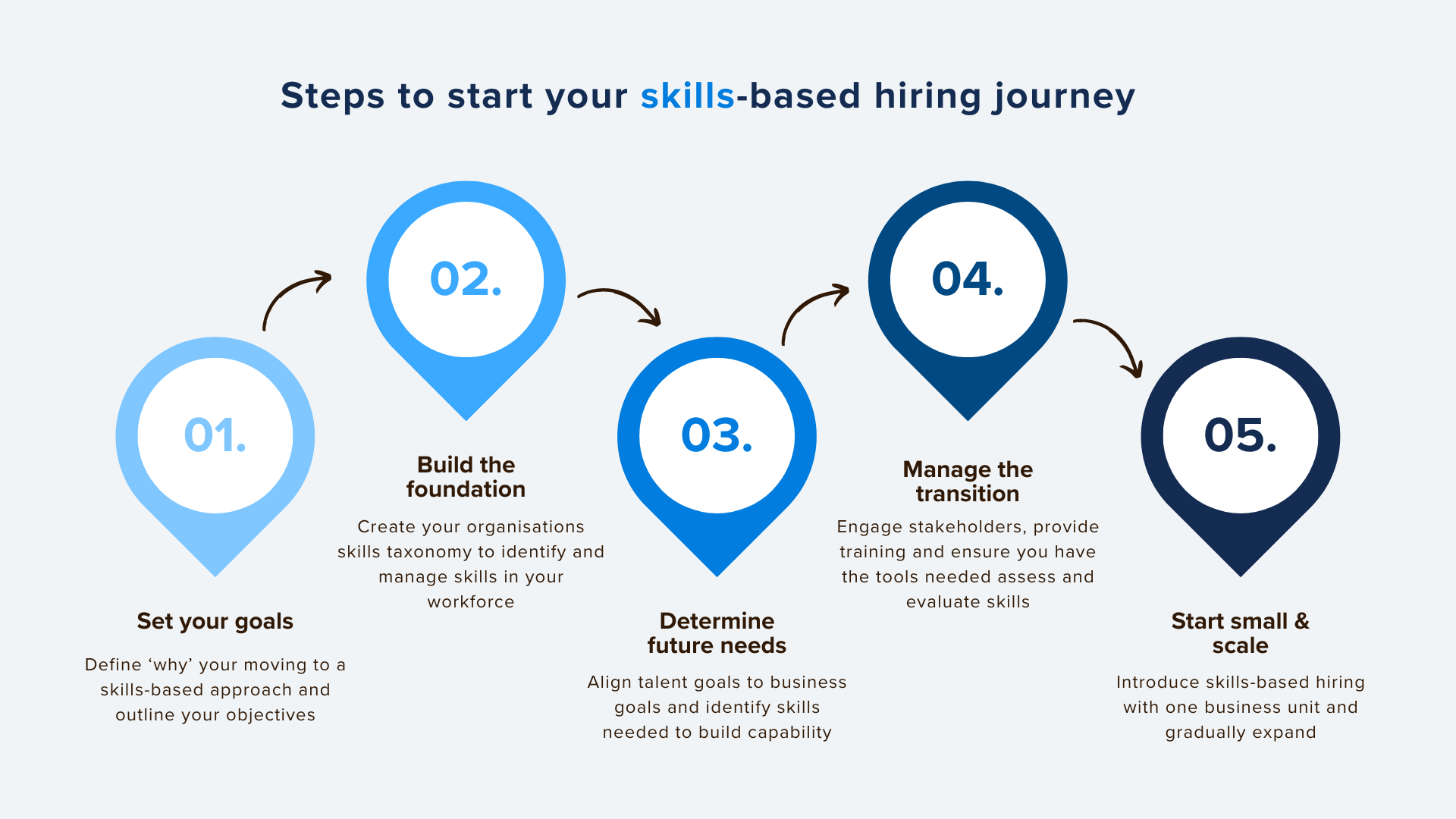
1. Set your goals Start by defining why you want to adopt a skills-based approach. Whether it’s to diversify your talent pool or build a more agile workforce, having clear objectives will guide your process. For example: “to access a more diverse talent pool” or “to build an agile workforce that can quickly adapt to future business needs.”
2. Build the foundation One of the main challenges is defining a common language for skills. A skills taxonomy categorisescategorizes skills into groups and clusters, making it easier to identify and manage them across your organisationorganization.
3. Determine future needs Align your talent strategy with your business goals. Identify the capabilities needed to meet future demands and the skills required to build those capabilities. This alignment helps you organiseorganize work around these skills, identify gaps, and refine your talent acquisition strategy.
4. Manage the transition Changing established mindsets and practices is the biggest hurdle. Engage and educate your stakeholders on the benefits and methods of skills-based hiring. Equip recruiters and hiring managers with the tools and training they need to assess and evaluate skills effectively. There’s no one-size-fits-all solution, so identify the different types of tools to meet your requirements and find what works best for your organisationorganization‘s unique needs.
5. Start small and scale Don’t try to overhaul everything at once. Start with a key talent segment or a specific business unit. Implement the approach, learn from the experience, and gradually expand.
Steps to running a skills-based hiring process
1. Engage stakeholders
As a recruiter, when commencing a hiring process the hiring manager is your greatest ally. Collaborate closely to define the essential skills of the position, leaving out those that can be easily taught on the job. Dive deep into the role’s daily tasks, challenges, and expectations by discussing them with managers, team members, or even department leads. This will provide valuable insight to prioritiseprioritize the most critical skills for the new hire.
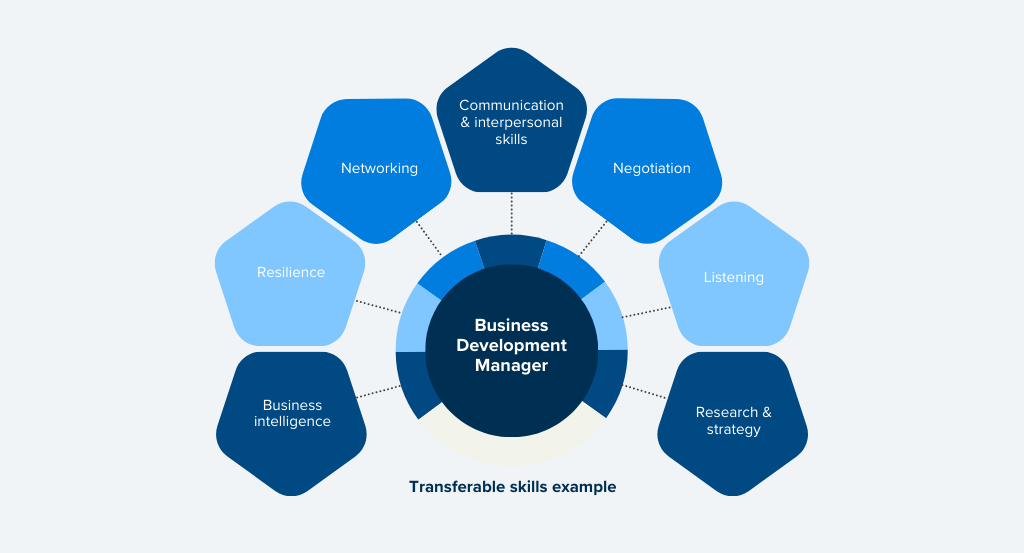
2. Identify transferable skills
Switching the focus from specific qualifications or roles to skills can greatly expand your talent pool. A common, dynamic understanding of the connections between skills allows you to spot transferable skills from candidates, even if they haven’t worked in your industry before. Here’s how to do it:
- Review the job description: Thoroughly examine the job description and responsibilities to pinpoint the necessary skills.
- Analyse similar job listings: Research and cross-reference similar job postings to get a broader view of the common skills required. Consider adjacent roles to understand transferable skill sets.
- PrioritisePrioritize essential skills: Focus on the must-have skills and avoid an overly long list that might scare off potential candidates.
- Include soft skills: Think beyond technical and hard skills. Consider essential soft skills, which are increasingly important, especially in hybrid and remote roles.
- Keep the future in mind: Think about how the role might evolve and what skills will be important in the future, including AI literacy and adaptability, which are now relevant across almost every function.
Once you’ve gathered this information, you’ll have a comprehensive list of skills required for the position.
3. Sourcing for skills
Now, it’s time to start your search and attract talent with the skills you’re looking for. Make sure to:
- Review the position description: Clearly outline the required skills, including technical and soft skills, and specify the level of proficiency needed. Clearly communicate the business impact of the role.
- Craft your job advertisementadvertizement: Focus on skills and capabilities, removing unnecessary qualifications that could deter good candidates. Use inclusive language to attract a diverse range of applicants.
- Consider both internal and external talent pools: Ask yourself if you can fill the position by upskilling current employees or if you need to hire externally. Use talent pooling to create a ready list of candidates whose skills are already known, making the hiring process quicker and more efficient.
4. Screening for skills
Recruitment technology plays a key role in supporting skills-based hiring. When screening resumes and candidate matching within your applicant tracking system (ATS), focus on skills rather than specific job titles or credentials. Be aware that candidates from other industries might use different terminology to describe their skills. This means a candidate’s resume might not perfectly match your search terms, but could still be a great fit. You’ll only know if you take the time to read the resume.
Watch out for unconscious bias: don’t make decisions based on education, degrees, or past employers. Instead, focus on the skills and potential a candidate brings to the table. It’s also important to bear in mind that with 45% of job seekers now using AI tools to enhance their resumes, manual screening alone is an increasingly unreliable filter.
This is where PageUp’s AI Skills Matching becomes a genuine differentiator. Rather than relying on keyword matching or gut feel, AI Skills Matching maps candidate skills directly against role requirements with precision and transparency. Recruiters can see exactly how a candidate stacks up across essential, important, and desirable skills, with clear ratings and supporting rationale for each, making it easier to spot strong candidates who might otherwise be screened out due to a non-traditional background. Importantly, the AI cannot be configured to automatically disqualify applicants. It’s designed to augment human judgement, not replace it.
This matters for skills-based hiring specifically because:
- It reduces credential bias: Matching is based on actual skills, not job titles or employer names. It also doesn’t compare candidates to each other, but to the job requirement which further supports reduced bias in the hiring process.
- It surfaces non-obvious candidates: Someone from a different industry might not match your search terms, but their underlying skills could be a strong fit. AI Skills Matching will find them.
- It creates consistency at scale: Every candidate is evaluated against the same skills framework, reducing variability across high-volume roles or different recruiters.
- It is designed to avoid perpetuating historical bias: unlike some AI tools, PageUp’s AI Skills Matching is intentionally prevented from learning based on your organisationorganization‘s past hiring decisions. This is a key safeguard against reinforcing any patterns or biases rooted in historical data.
- It gives recruiters time back: Rather than reading every resume before shortlisting, recruiters can focus their attention where it matters most.
Pair AI Skills Matching with AnonymisedAnonymized Profiles (which hide identifiable candidate information to reduce bias) and CV SummarisationSummarization (which generates concise, consistent skill summaries) for a screening process that is faster, fairer, and more accurate.
5. Selecting for skills
Finally, assess candidates’ capabilities through interviews, assessments, and tests. Competency-based interviews, which use behavioural and situational questions, are a great way to evaluate specific skills. For example, ask: “Describe a project where you had to use different leadership styles to reach your goal” or “Tell me about a time you needed to influence people with different priorities from yours.” These questions help you understand how candidates apply their skills in real situations.
Use various assessments, such as psychometric testing, job knowledge tests, and practical assignments, to evaluate candidates’ skills. These assessments help ensure that you’re selecting candidates who are not only capable for the role but also fit well within your organisationorganization.
The future of skills-based hiring
The future of skills is rapidly evolving, and AI is making it possible to execute skills-based hiring with a level of rigour and scale that wasn’t previously achievable. By embedding a skills-based approach within your organisationorganization, and pairing it with the right technology, you can tap into a broader talent pool, foster a more inclusive workplace, and build the agility to meet whatever comes next.
Use these steps to get started, build on them, and adjust to meet your organisationorganization‘s needs. And remember: ensuring you have stakeholder buy-in and the technology to execute is crucial to running a skills-based hiring process effectively.
Learn more about how the PageUp Talent Acquisition Suite, including AI Skills Matching, can support you on your skills-based hiring journey, and request a demo today.
Fresh insights for HR
Stay up to date with HR trends, tips and more when you sign up for our industry newsletter